
Fox has a specific problem with the Baywatch reboot it launches in January 2027. The people who remember the original are not the people who decide what is worth watching on television anymore, and the people who do decide have no particular reason to care about a lifeguard show from before they were born. The standard answer to that problem is a paid media push timed to the premiere, a trailer buy, some out-of-home, a late-night hit. Fox did something cheaper and, on the evidence so far, smarter. It handed the show to sorority chapters and let them make the content.
The campaign ran through CampusLaunch, a college marketing agency, in partnership with Fox, and it has so far produced six reels from four chapters, posted between October 15 and 17. SDSU's Alpha Phi put roughly 150 members on a beach in custom red one-pieces with inflatable rescue boards and signs reading "Trailer Out Now." Miami's Delta Phi Epsilon danced at Crandon Park. ASU's Delta Zeta shot on a pool deck. UCF's Kappa Delta filmed indoors and then on a lawn. Within hours, cast members including Livvy Dunne, Noah Beck and Stephen Amell were in the comments, which is the part Fox actually paid for in attention if not in cash.
Why this works, and why it is not an accident
The sorority recruitment video has been one of the most reliably viral formats on the internet for three years running. Rush season produces an annual flood of coordinated, high-energy, attractive-people-in-matching-outfits dance content that the algorithm has been trained to push and that audiences have been trained to stop on. It is a format with a built-in audience, a built-in cadence, and a built-in aesthetic.
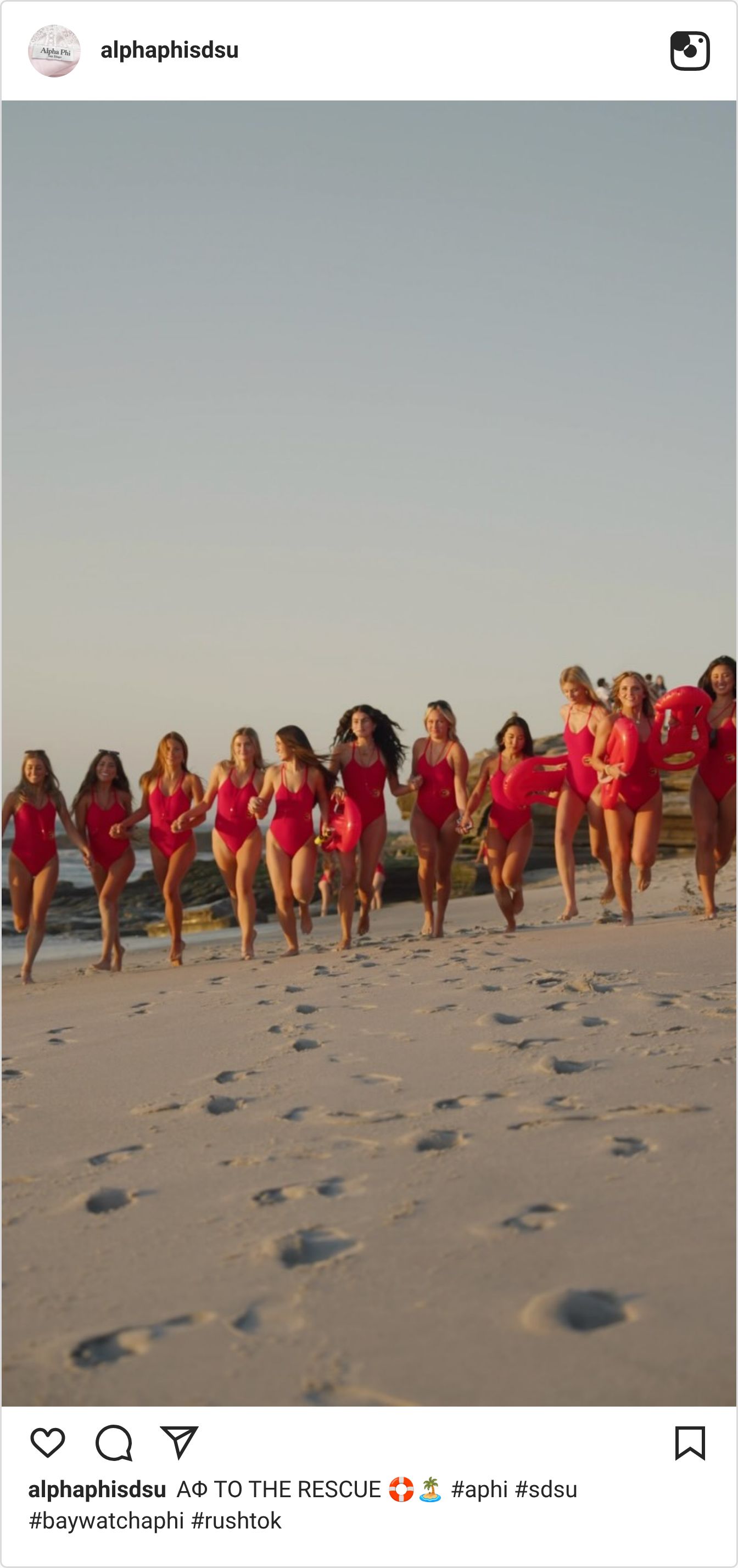
What Fox understood is that Baywatch is one of the few pieces of legacy IP whose entire visual language already lives inside that format. Beach, run, red suit, slow motion. A studio trying to force a lifeguard show into a dance trend would look desperate. A studio that recognizes its IP was practically designed for the dance trend just supplies the suits and gets out of the way. The smart decision was made at the casting stage, which is to say the choice of which IP to point at the format, not the execution.
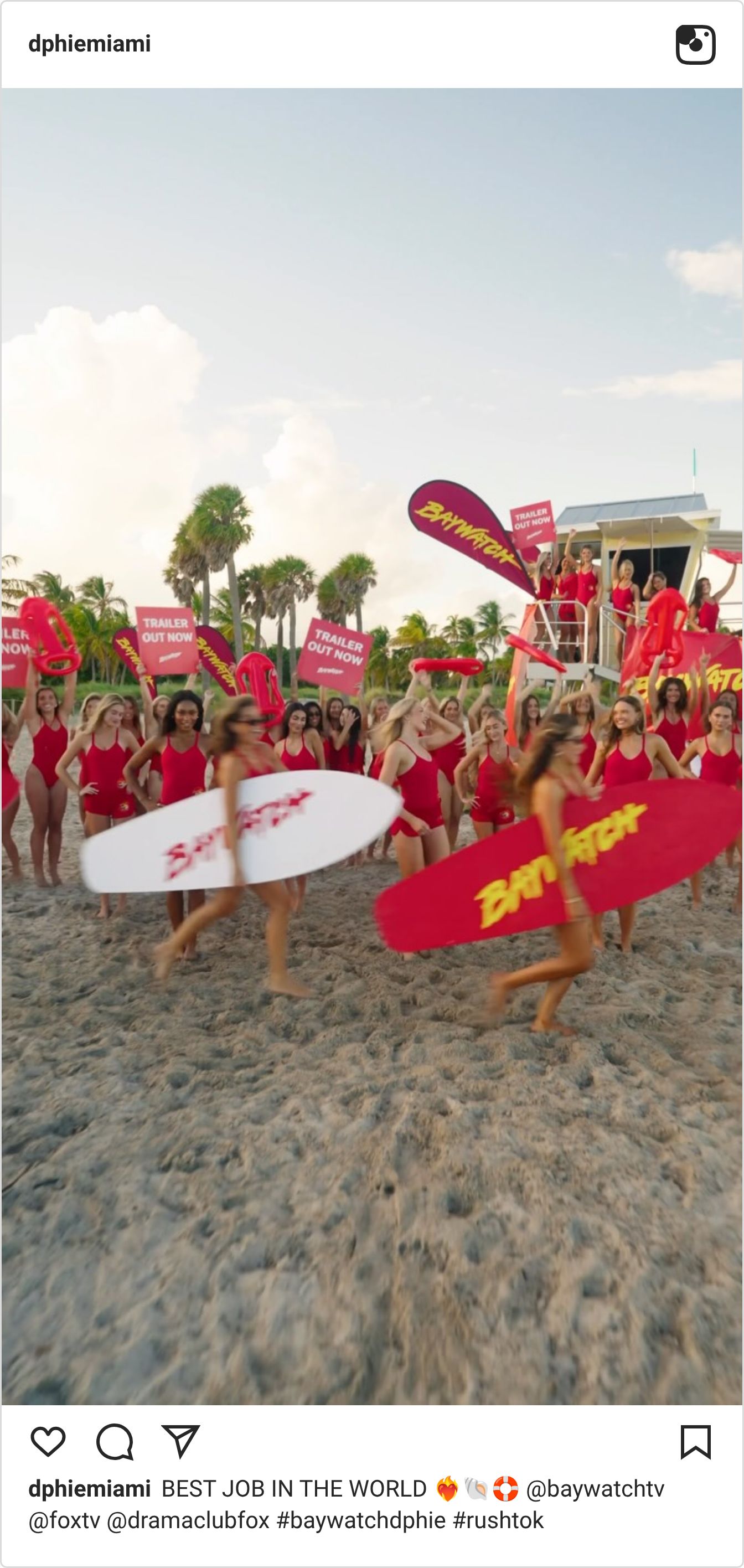
That is the same logic that has run through the campaigns worth covering this fall. The studio builds the set and the creators supply the thing that actually travels. Whalefall built a 4DX event so that 40 creators would make native content. Fox bought red swimsuits so that four chapters would make rush videos. In both cases the authenticity is real at the level of the creator and manufactured at the level of the brief, and in both cases that is the point rather than a problem.
The reel that looked least like Baywatch won
Here is the finding that makes this more than a cute stunt. The best-performing reel in the set is not the one with the beach and the red suits and the rescue boards. It is ASU Delta Zeta's pool-deck video, the one with the least Baywatch set dressing of any of them. It pulled 5.4K likes and 260 comments. The two beach reels that leaned hardest on the Baywatch iconography, SDSU's run and Miami's dance, landed at 2.2K and 3.1K. The lesson is uncomfortable for anyone who thinks the brand assets are doing the work. They are not. The format is doing the work, and the Baywatch dressing is a reason for the format to exist this week rather than the engine of its reach. Energy, choreography and the native rush-video rhythm carried the engagement. The red suit was set dressing on top of it.
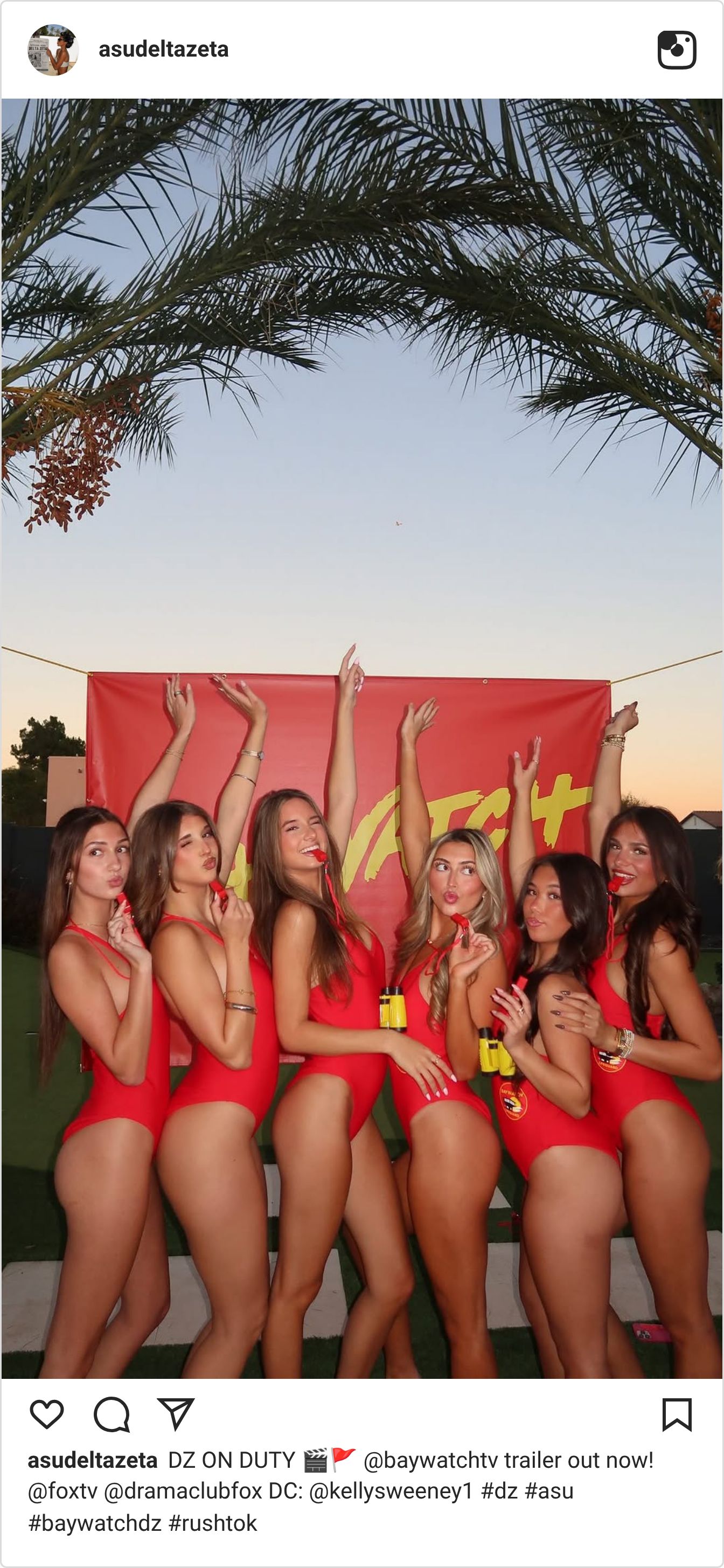
This matters for how a studio should brief a campaign like this. The instinct is to maximize brand presence in every frame, more suits, more logos, more "Trailer Out Now." The data points the other way. The chapters that made the best native content, on the terms of the format rather than the terms of the brand, are the ones the algorithm rewarded. Over-branding the content would have made it perform worse, not better.
What the visible numbers are not telling you
Across all six reels, the public counts add up to roughly 15.5K likes and 865 comments as of this writing. That is a respectable chapter-level result and it is nowhere near the whole story, which is the part a careful marketer has to say out loud rather than rounding up.
Chapter-account likes are a floor. They miss impressions, shares, saves, the reach from cast members re-posting to far larger followings, and whatever paid amplification Fox ran behind the organic posts. None of that is publicly visible, and all of it is where the actual distribution lives. A campaign like this one is architected on a Meta business account that can see cost per impression and reach, and the chapter likes are the one layer that happens to be exposed to the public. Judging the campaign on them is like judging a film on its Thursday previews.
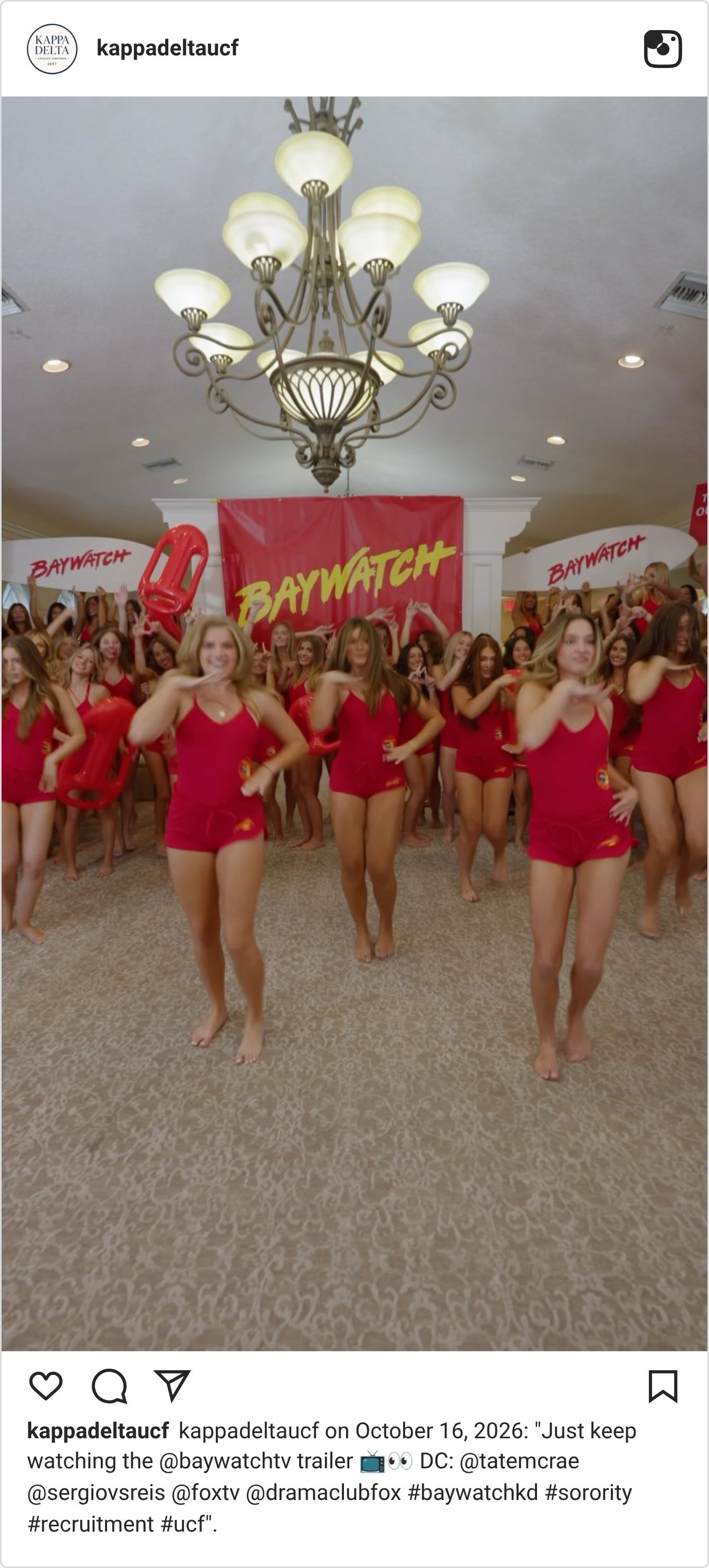
The number that would actually settle whether this beat a paid January trailer buy is cost per impression on borrowed authenticity, and it sits inside Fox's account rather than on the chapters' grids. The honest read is that the visible engagement is modest, the invisible engagement is probably the point, and the superlative CampusLaunch is using, "one of the largest sorority collabs of all time," is their claim and not a verified fact. Four chapters and 15.5K visible likes will not support it if a reader does the arithmetic, so attribute it rather than repeat it.
Search tells a different story than engagement
The reels moved social engagement. They did not, on the evidence, move search, and the distinction is the most useful thing in this issue because it separates two jobs that marketers routinely conflate.

Google search interest for Baywatch sat at a baseline around 23 through the first ten days of October. Then the full trailer dropped on October 13 and interest spiked to 94 almost overnight. That spike is the trailer, not the sorority videos, which had not posted yet. Through the sorority window of October 15 to 17 interest held at roughly 2.7 times baseline, with a secondary bump on the seventeenth, which is the one data point that could plausibly belong to the campaign. Then interest climbed again and actually peaked on October 25, more than a week after the last reel, which lines up with Fox announcing the January 6 premiere date and cast around October 26, a reveal that confirmed original star David Chokachi returning as Cody Madison. The largest query risers across the window were news terms rather than campaign ones, led by "baywatch 2027" at up 400% alongside a surge in original-cast searches, which points at the announcement rather than the sorority content.
The honest conclusion is the interesting one. The trailer and the cast news drove search intent, the thing people do when they want to find out about a show. The sorority campaign did something different and quieter, which is keep the title culturally present and socially active in the window between the big beats, so that interest held above baseline rather than falling back the way it usually does after a trailer burns off. Crediting the influencer campaign with a search spike it did not cause would be wrong. So would dismissing it for failing to cause one, because search was never the lever it was pulling. Engagement and intent are different channels doing different work, and the mistake most campaigns make is measuring one and claiming the other.
What is transferable
The move here is repeatable, but only under conditions most campaigns do not meet. It requires IP whose aesthetic already fits a format the audience is primed to engage with, creators who are given enough room to make content on the format's terms rather than the brand's, and a willingness to measure the thing in the account rather than the thing on the grid. Fox had all three. A studio that bolts its logo onto a trend its IP does not fit, briefs the creators into stiffness, and then celebrates the vanity likes will get none of the lift and spend more to not get it.
The reboot still has to be good, and a sorority dance cannot fix a bad show. But for the narrow job of making a dormant 90s property feel present to an audience that has no memory of it, four months before anyone can watch it, this is close to the most efficient thing Fox could have done.
Movie marketing intel: This week in trends
STREAMING 🎬 TikTok and Made By Us sign a multiyear deal to co-produce vertical series Announced at MIPCOM on October 14. TikTok is co-producing a slate of creator-led microdramas for the app and its PineDrama player, with the first two titles starring Hannah Stocking in a romantic revenge thriller and Adam Rose in a horror series, both with the creators attached from development. The precedent the companies keep pointing to is Issa Rae's Screen Time, which has drawn close to 580 million views across both apps. The vertical microdrama is quietly becoming its own production category rather than a promotional format.
INFLUENCER DATA 📋 Influencer Marketing Trends: October 2026 New Engen's monthly read on where creator spend is heading. The notable shifts this month are Meta's new Creator Marketing Hub, which merges creator discovery with paid amplification so brands can turn organic posts into ads without per-post approval, and eMarketer's projection that micro and nano influencers will take 45.5% of influencer spend in 2026. Worth a scan for anyone budgeting creator work into 2027.
This week's movie review: Wildwood ★★★★ (4/5)
Travis Knight and Laika have made the most beautiful film of their run, a 140-minute stop-motion adaptation of Colin Meloy and Carson Ellis's novel, anchored by Carey Mulligan and Mahershala Ali and a production design that earns every dollar of its reported hundred-million budget. It runs long and the middle act wanders, but the PG-13 ambition gives the fairy tale a weight Laika's earlier work only gestured at. The tragedy here is a marketing one, not a creative one.

