
The "marked" symbol appears early in the Passenger trailer. Three red lines scratched beneath a stick figure. The trailer explains what it means: if you carry the mark, the Passenger has claimed you. Paramount took that symbol off the screen and put it on real cars: black cards tucked under windshield wipers in parking lots, no studio logo, no URL, no explanation. Just the mark. The horror community did the rest.

The second signal came from Blumhouse, which joined as executive producer after the deal closed. Blum's name on the poster is a shorthand that lowers the awareness-to-intent gap that every low-budget horror film has to bridge. By the time the campaign launched, the credibility infrastructure was already built.
The flyer as in-world object
The Blair Witch Project distributed missing-person flyers for its cast at the 1999 Sundance Film Festival, formatted like real law enforcement documents. It tied red balloons to storm drains in cities ahead of the 2017 release - a direct reference to Pennywise mythology that required no copy, no branding, and no explanation. The object spoke for itself.
Passenger's marked flyer operates on the same logic. A black card with a hand-drawn red stick figure under a windshield wiper reads as genuinely unsettling before it reads as advertising. The discovery moment - returning to your car, finding something on your windshield you did not put there - is already a mild form of dread. Horror community accounts like @buzzingforhorror posted about the flyers immediately, tagging @PassengerMovie and explaining the symbol's meaning. The post was reshared 27 times before the end of the day.
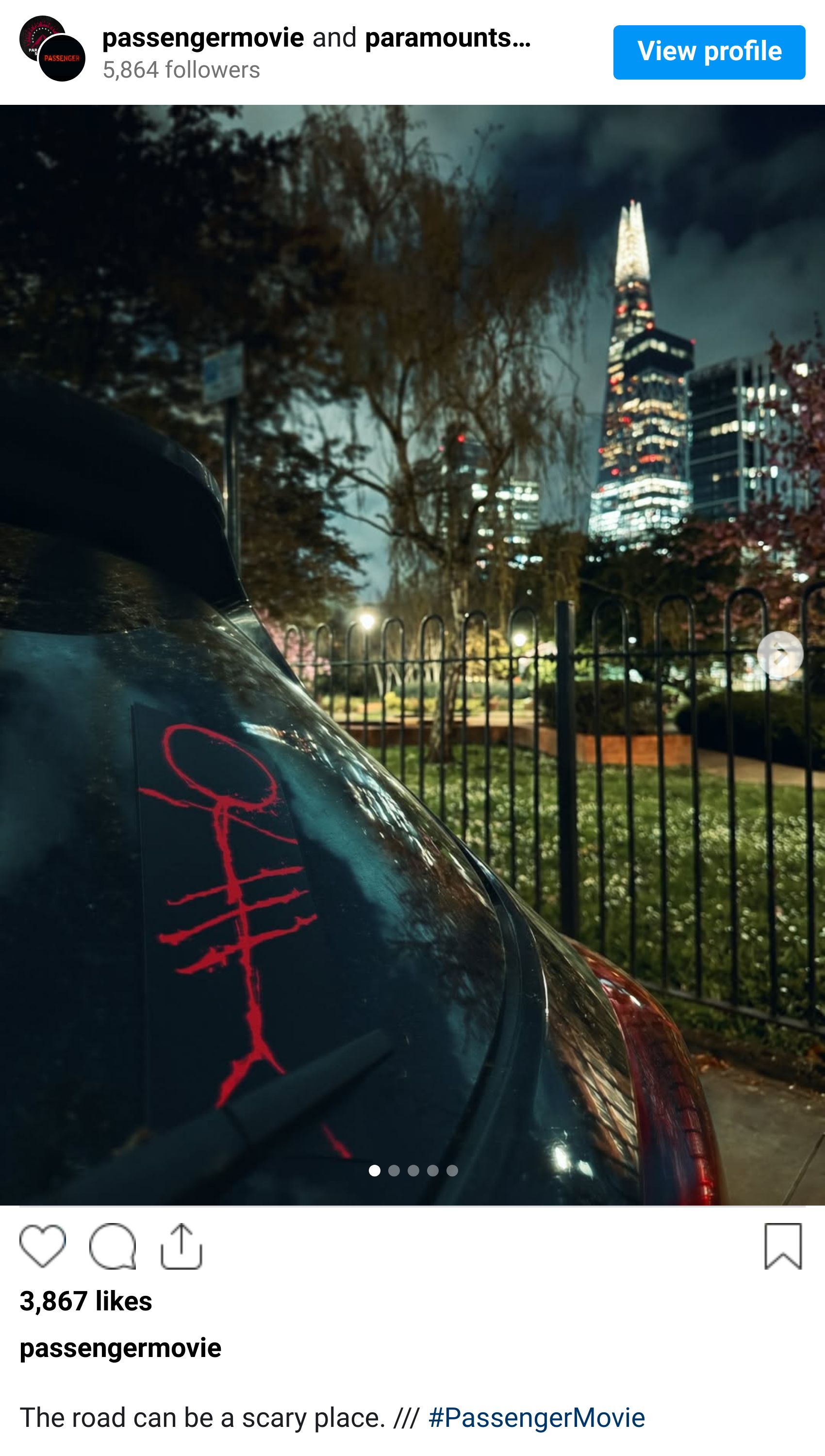
What makes the execution precise is what is not on the card. No QR code, no release date, no tagline. Just the mark. Every additional piece of information shifts the object from discovery to advertisement. Paramount resisted that. The flyer is a prop, not a flyer.
The marked flyer did not operate alone. In January, Paramount attached a theater-exclusive teaser to prints of Primate - approximately 60 seconds, no score, structured like a scene from the film. Dread Central confirmed it was theater-exclusive: the only way to see it was to already be in a horror film. That gatekeeping is the mechanism. The person in a theater watching Primate is not a general audience member who might be interested in horror. They are a horror audience member who has already committed - bought a ticket, sat in the dark, chosen to be scared. Putting a teaser in front of that person is the highest-conversion placement available to a horror film.
The secondary effect is social. TikTok creator Jeff Rauseo posted about it the same night, calling it "basically a terrifying short film that had my whole audience shook" - 1,330 likes, 52 comments, and dozens of similar posts from other horror fans who had been in the room. The exclusivity manufactured the word of mouth. Posted to YouTube, it would have been viewed and forgotten.
The full trailer then opened with a title card: "130 million people take road trips every year. 15,400 of them are never seen again."
That line does the work the flyer and teaser set up. It roots the film's threat in a statistic that implies the horror is already real and ambient. You do not need to be watching a horror film to be at risk. You just need to be driving.
What the van life angle adds
Beyond the general horror audience, Passenger is targeting the van life community specifically - a subculture on YouTube and TikTok that is deeply invested in road culture and predisposed to content about the specific anxieties of life lived in transit. A film about a couple whose van life adventure becomes a supernatural nightmare is not a generic horror pitch to this community. It is a film about something they already think about. The marked flyers placed on cars are reaching that audience in the one physical context that defines their lifestyle. Paramount is not advertising to van life people. It is haunting them.

The tradition Passenger is working in -- Blair Witch flyers at Sundance, Paranormal Activity's city-by-city Demand It rollout, It's red balloons on storm drains -- has a strong commercial record. The marked flyer on your windshield is the 2026 version of the same insight: the best horror marketing does not interrupt you. It finds you somewhere you already are, plants something that does not belong there, and leaves before you can ask who put it there.
Movie marketing intel: This week in trends
EXHIBITION 🎬 Passenger opens May 22 as counter-programming to The Mandalorian and Grogu, testing at a 25% over-index with horror audiences (Deadline) Paramount moved the film from May 29 to May 22 to avoid direct competition with Backrooms and Scary Movie, positioning it against The Mandalorian and Grogu as adult horror counter-programming. The film is testing well with a 25% over-index among horror audiences, and André Øvredal's track record with Scary Stories to Tell in the Dark gives it pre-existing credibility with the genre community. The campaign's physical and theatrical tactics are doing awareness work in exactly the right channels ahead of a weekend where the general audience is pointed firmly at Mandalorian.
CAMPAIGN STRATEGY 📋 How Hunting Matthew Nichols used missing-person flyers, a Griffith Observatory banner, and a $0 ARG to earn 1,000+ screens from Regal (Variety) Moon7's indie horror debuted with a shoestring guerrilla campaign tipping its hat to Blair Witch: a flyover banner near Griffith Observatory reading "Help Us! FindMatthewNow.com," hundreds of missing-person flyers with QR codes that drove 5,000+ organic scans, and an ARG website where fans could solve the mystery themselves. The campaign impressed Regal enough to offer 1,000-1,200 screens -- far beyond what the team expected. Director Oliver Crawford: "They wanted to understand, do you know who your audience is, and do you have a plan to get to them." The Passenger campaign answers that question the same way, at studio scale.
This week's movie review: Obsession ★★★ (3/5)
Obsession's first two acts are nearly perfect: a slow-burn romantic horror that understands how desire and unease occupy the same register. The third act rushes the mythology in ways that feel like a studio note rather than a director's choice. Worth seeing.
