
The standard creator play for a film launch has barely changed in five years. A studio invites a roster of creators to a premiere or a screening, hands out a gift bag, provides a hashtag and a link, and hopes the posts clear whatever engagement floor the agency promised. The content that results is almost always the creator's normal format wrapped around a piece of marketing that does not belong in it. A beauty creator holds a poster. A food creator mentions a release date. Audiences have been trained to recognize the shape of that content and scroll past it, which is why reported engagement on film influencer campaigns has been sliding even as the budgets have grown.
Whalefall's trailer launch in late September did something structurally different, and the difference is worth examining closely because it is repeatable. The team built an immersive 4DX screening at AMC Lincoln Square and designed each physical element of the room around a specific creator archetype. More than 40 creators attended. None of them were asked to make a film marketing video. They were put inside an experience that generated their normal content for them.
The activations were cast before the creators were
Look at what was actually in the room. Heart rate monitors tracked attendee stress responses during the screening, which is the entire native format of a reaction creator, handed over as a prop with a built-in data readout. Spaghetti sliders, referencing a plot beat in the film, gave food creators a branded menu item to shoot and react to. The 4DX water effects and a replica whale ribcage that attendees physically crawled through produced the sensory footage that spectacle and experience creators build their channels on. A director Q&A served the film literacy audience, the creators whose viewers expect craft discussion rather than stunts. Limited edition shirts created the scarcity signal that drives I-was-there posting.
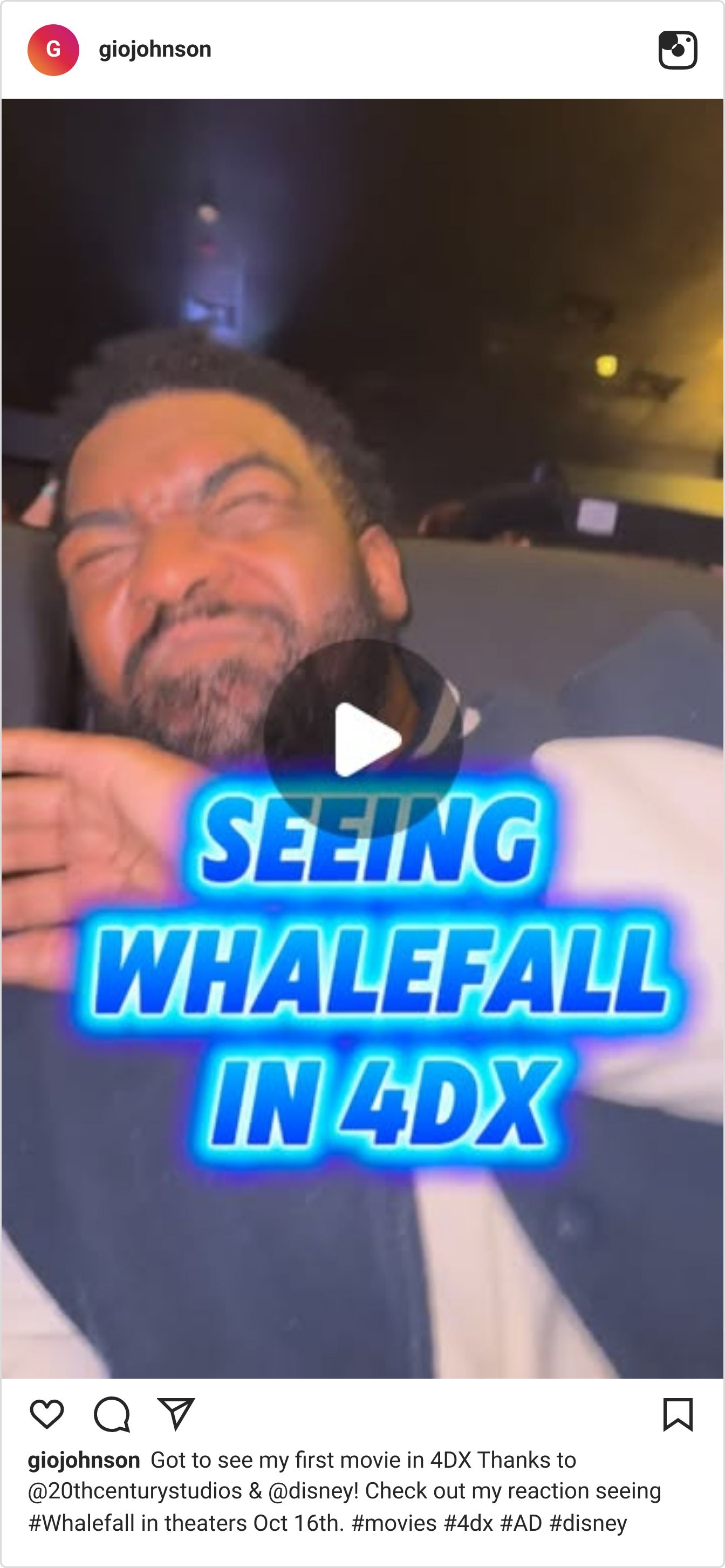
Five activations, five distinct content categories, all running simultaneously in one room on one night. That is the part most campaigns miss. The usual approach builds one activation, typically a photo moment, and then invites every creator to stand in front of it, which produces 40 versions of the same video and a feed that looks coordinated in the worst way. Whalefall built five different things and let each creator walk toward whichever one matched what they already make.
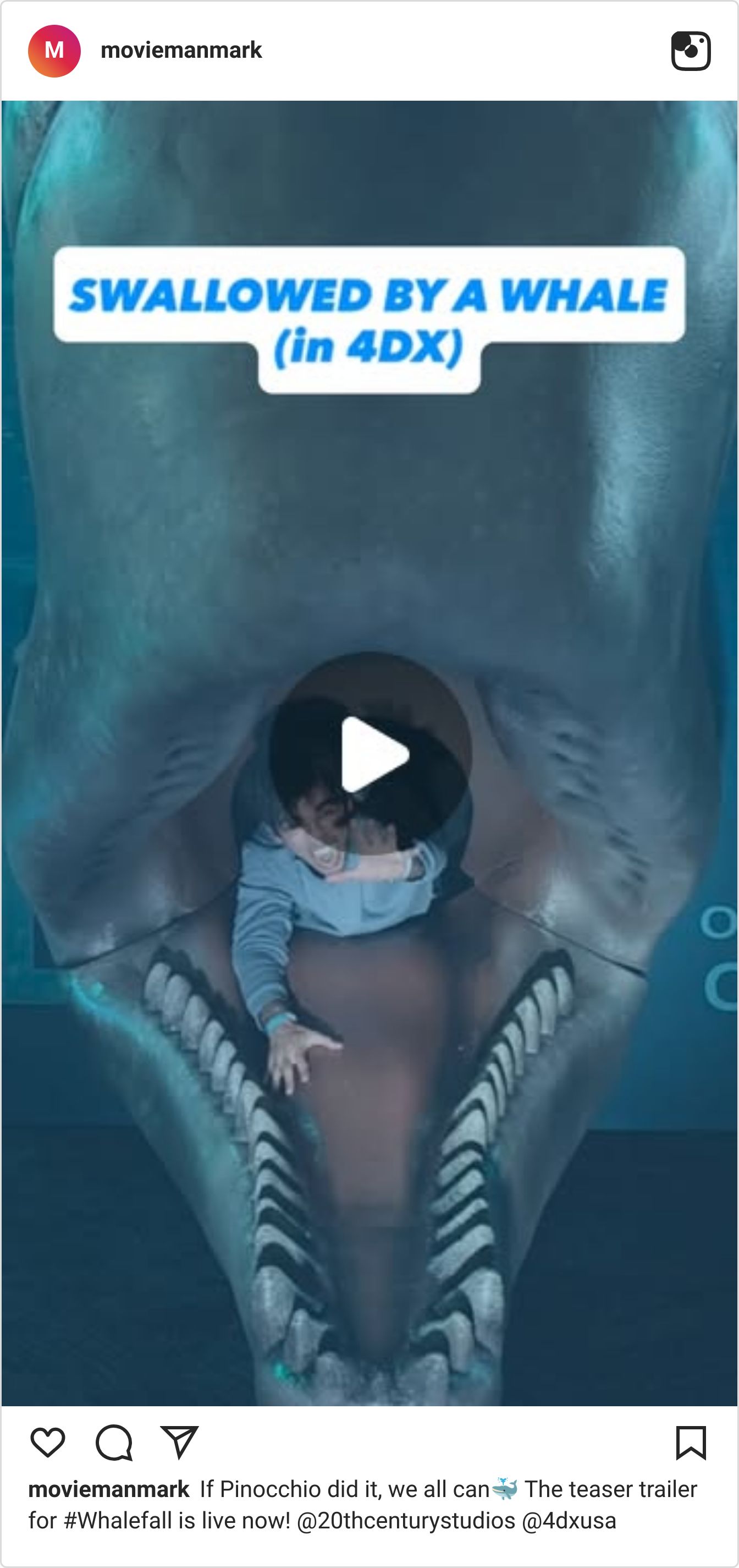
The clearest evidence it worked is a reel from @anthonyiscoping, a comedy creator who ran the event through his own comedic register and cleared 900,000 views. There is no talking head product mention in it and no poster hold. It reads as a comedy video about a strange night, because that is what it is. The campaign is present in the video only as the setting.
The returns on building something people can film
This is not a new finding so much as an underused one. The mid-budget films of the past three years that built a physical, documentable thing into their campaigns have consistently outperformed comparable films that ran a conventional trailer and paid media schedule, and the gap is wide enough that it is difficult to attribute to the films themselves.

The four films in the upper group all gave people something to film. Smile planted unsettling smiling actors in the stands at nationally televised baseball games. M3GAN built a dance that creators could perform, which is the single most replicable content unit on short form video. Longlegs ran a cryptic phone number and coded materials that audiences had to decipher collectively. Five Nights at Freddy's leaned on a fan base that had been producing content about the games for a decade and gave them screening events to document. In each case the campaign produced an object or an action rather than an impression.
The authenticity was manufactured, and that is the interesting part
There is a tension here worth sitting with rather than resolving. The Whalefall content felt native because the creators were genuinely experiencing something. The water was real, the ribcage was real, the heart rate data was real, and the reactions were not performed. But the experience existed because someone on the marketing team decided in advance which archetype of creator would post a food video and then put a spaghetti slider on a tray for them.
@wearmichelletravels Watching a film in 4DX is like fighting for your life 😭 Whalefall is out Oct 15th.. buckle up! @20th Century Studios @teagan_dionne @JVMI... See more
That is the actual mechanism, and campaigns that pretend otherwise tend to build worse events. The failure mode of influencer marketing is asking a creator to carry the campaign's message in their own voice, which audiences hear as ventriloquism. Whalefall inverted it by building a campaign that creators could document in their own format without carrying anything. The authenticity is real at the level of the creator's experience and engineered at the level of the room. Both of those things are true at once, and the second one is what made the first one possible at scale.
Release week is the unclaimed half of this campaign
The trailer launch is done and the numbers were good. The structural advantage Whalefall built, though, is still mostly unspent, because more than 40 creators now have a documented relationship with this film and an audience that already watched them experience it.
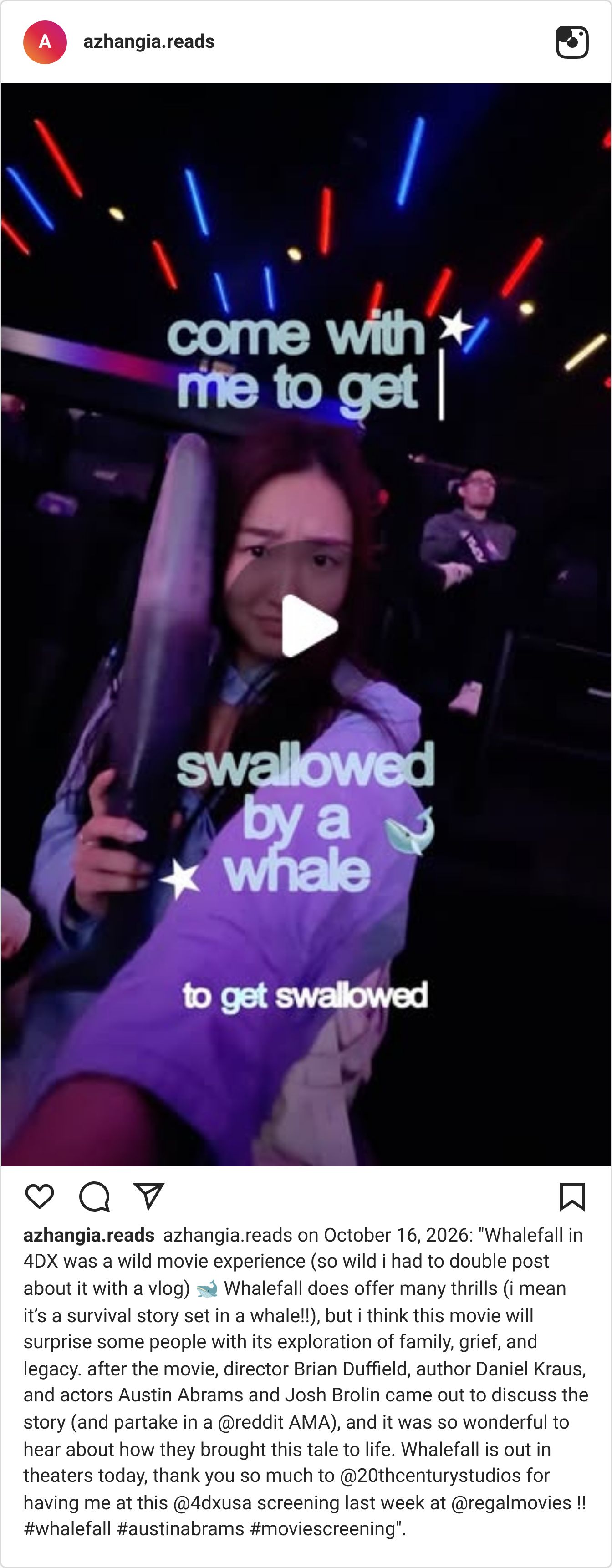
A coordinated release week push from the same creator base would carry something a fresh influencer buy cannot purchase, which is continuity. Audiences who saw the ribcage footage in September would recognize the same faces walking into an opening weekend screening. The creators would not be introducing a film, they would be returning to one, and the return is a format in itself. Part two content reliably outperforms part one content on every short form platform, for the obvious reason that the audience has already opted into the story.
That continuity has a shelf life. It decays as the creators post about other things and the September content falls out of their feeds. The window to use it closes well before release week arrives, which means the decision about whether to run it has to be made now rather than during the release campaign.
Movie marketing intel: This week in trends
CAMPAIGN ECONOMICS 📋 Studios are mispricing built-in audiences, and a $750,000 horror film just proved it
Film Threat breaks down the economics of a horror release made for roughly $750,000 on a 20-day shoot that returned in the tens of millions. The piece makes three arguments. Micro-budget risk is asymmetric, because a $750,000 film clears its costs on a modest theatrical run while a $75 million film needs a genuine hit to break even. Overhead is close to zero, with no star salaries or padded shoot schedules, so every dollar lands on screen. And the director's existing YouTube subscriber base removed most of the marketing spend a studio would normally carry, which Film Threat calls a pricing error in how the industry values audiences that already exist. For contrast it notes that a $120 million franchise sequel can spend roughly half its production budget again on marketing.
AUDIENCE RESEARCH 🎬 The marketing that moves 13 to 39 year olds is content they make themselves, not content studios buy
YPulse surveyed 1,500 US and Canadian 13 to 39 year olds across July and August for a report on why young audiences are returning to theaters. Its argument is that Gen Z is driving the theatrical revival streaming was supposed to end, and that online culture now determines which films break out, pointing to YouTuber-directed releases, the horror box office, fan edits, and Letterboxd. The report covers what pulls the group into theaters, which marketing formats actually influence them, which genres they want more of, and how brands are attaching to blockbuster hype through pop-ups and merchandise.
This week's movie review: Digger ★★★ (3/5)
Clara Osei lets the strangeness accumulate through texture and fieldwork rhythm rather than event, and for two acts that patience is the film's best quality, carried by a quietly commanding Saoirse Ronan. The third act gives way, resolving the ambiguity that was the whole reason to watch. Worth it for the first 80 minutes.
